Object record
Identification, material description, and access state.
| Object | Compilation of an iatromathematical onomatomantic engine, a 28-mansiones-lunae apparatus, a world-alphabet inventory, and a closing computus/sanctorale colophon, in German vernacular, translated by Johannes Hartlieb. The Mondwahrsagebuch tract proper is not carried by this codex. |
|---|---|
| Repository | Bayerische Staatsbibliothek, München. |
| Shelfmark | Cgm 7958 (Codices germanici monacenses 7958). |
| Date | Anno 1456 (archivist annotation on the manuscript). Compilation 1455/56. |
| Material | Paper. (Substrate confirmation pending direct codicological inspection note.) |
| Extent | 25 leaves. |
| Language | German vernacular (Bavarian-Austrian register), translated from Latin authority sources. |
| Digitization | Completely digitized at source by Bayerische Staatsbibliothek (BSB-MDZ). |
| Access | Public access at source. Image rights as per BSB-MDZ terms. |
| Preferred citation | München, Bayerische Staatsbibliothek, Cgm 7958. |
Record state
Foliation, binding, conservation, and digitization status.
Foliation is modern throughout the 25 leaves, with no flagged lacunae in the BSB catalogue record, and the fol. 9 hand carries the load-bearing authorship attestation. The codex is currently in a library binding consistent with the BSB Cgm series; original binding state is not recorded in this draft and is not load-bearing for the content reading. A complete digital surrogate at BSB-MDZ allows direct folio inspection of the apparatus structure, lunar-mansion ring, weekday table, name-sum chart, outcome wheel, without requiring a reading-room visit.
Content
The codex carries four working components in a single iatromathematical compilation. They share an authority chain (Aristoteles / Plato / Haly Ibn Ridwan) and read as a single working apparatus rather than as separately bound tracts. The component naming below reflects direct image inspection of the BSB-MDZ surrogate, not older catalogue ambient language.
Onomatomancia / Namenmantik (iatromathematical onomatomantic engine)
Name-sum divination apparatus running on a letter-value table, a name-sum computation, and a closing outcome wheel. The apparatus computes a numeric value from the letters of a queried name and returns a directed reading. This is the load-bearing engine of the codex and the component most directly self-attested to Hartlieb on fol. 9.
28-mansiones-lunae apparatus
A 28-mansion ring drawn from the Arabic manāzil al-qamar tradition, paired with a weekday-value system. Each mansion is paired with prognostic outcomes and supports a weekday-value computation that returns a directed reading from a name-and-day pair. The apparatus is structurally a lunar-mansion ring used as the time-coordinate of the onomatomantic engine, not the standalone Mondwahrsagebuch tract (which is a separately named Hartlieb work carried by Cpg 6, HAB Cod. 29.14 Aug. 4°, and Wien Cod. 3062).
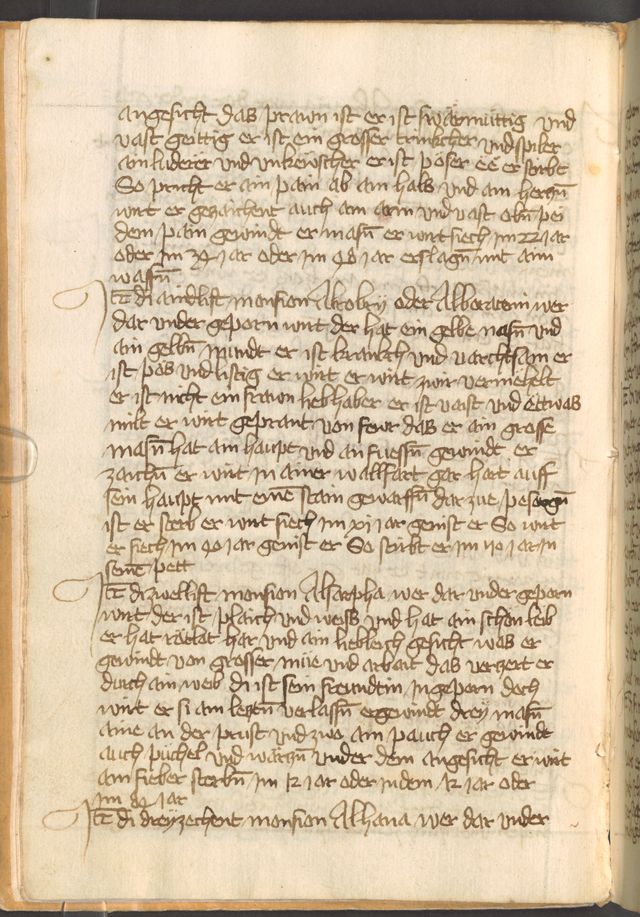
CGM7958_28_MANSION_TRANSLATION_TABLE.tsv in the working substrate for the full TSV of all 28 mansion entries.
World-alphabet inventory
An inventory of letter-shapes drawn from multiple alphabet traditions, paired with the onomatomantic engine's letter-value table. The inventory provides the substitution surface used by the name-sum computation. The dual Greek alphabet pair (formal Grecorum fol. 22v / vernacular Krechysth fol. 23r) is recorded here as part of the source-tradition program.
![München, BSB, Cgm 7958, fol. 22v. Formal Latin register of the world-alphabet inventory. Red headers: Alphabetum Ethyopicum, [Al]phetum Transpositum, Alphabetum paganum, Alphabetū Grecorum, Alphabetū de Regno arabie, Alphabetum Hebraicum (with Latin Hebrew letter names: Aleph, Beo, Gymel, Daliß…), Alphabetum antiquum (Latin alphabet).](assets/img/cgm7958_alphabet_p48.jpg)
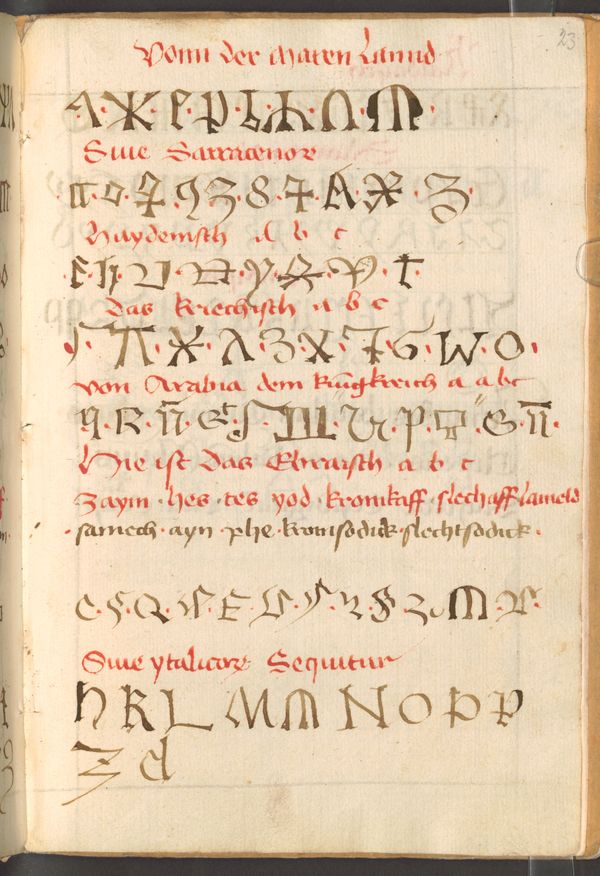
The two facing pages give the same inventory in two registers, formal Latin (fol. 22v) and vernacular German (fol. 23r). This is the substrate finding documented in CGM7958_FORMAL_VS_VERNACULAR_GREEK_REGISTER_FINDING_2026-05-16.md. The dual register is part of why Cgm 7958 reads as a translation/compilation working document rather than a single authored treatise.
Computus/sanctorale colophon
The closing leaves carry a computus/sanctorale colophon; a liturgical-calendar closing section that times the apparatus to the church year and records the scribal context. This colophon repeats the Hartlieb attribution but should be read as a stylistic closing rather than as independent evidence beyond the fol. 9 attestation.
| Authority chain | Aristoteles → Plato → Haly (Ibn Ridwan) → Hartlieb German translation. The chain is named in the apparatus itself and follows the standard pseudo-Aristotelian and Arabic-mediated iatromathematical tradition of the 14th–15th centuries. |
|---|---|
| Apparatus components | Letter-value table; name-sum computation; 28-mansiones-lunae ring; weekday-value system; outcome wheel; world-alphabet inventory; closing computus/sanctorale colophon. |
| Function | The apparatus answers directed questions (e.g., prognostic outcomes for a named subject on a given lunar mansion and weekday) via a closed computation that returns to the outcome wheel. |
Authorship attestation
The attribution to Hartlieb is direct and in-manuscript, with a hedge on the closing colophon.
| Load-bearing attestation |
fol. 9, opening attribution (manuscript-direct reading 2026-05-21 against the BSB-MDZ IIIF surrogate): "Das puch hat zu deütsch pracht meister hanns hartlieb doctor medic[us] durch pett willen der edeln wolgeporn frawen Katherina." ("This book has been brought into German by Master Hanns Hartlieb, doctor of medicine, at the request of the noble well-born Lady Katherina.") This is the in-manuscript hand and the primary basis for the Hartlieb attribution. The colophon names Hartlieb as translator/compiler ("zu deütsch pracht"-"brought into German"), not as author of the underlying tract. The "-us" abbreviation on medic[us] is the standard 15th-c. Latin brevigraph. ![München, BSB, Cgm 7958, fol. 9r. The upper-half text block ends with the load-bearing Hartlieb attribution colophon: 'Das puch hat zu deütsch pracht meister hanns hartlieb doctor medic[us] durch pett willen der edeln wolgeporn frawen Katherina.'](assets/img/cgm7958_authorship_p21.jpg)
|
|---|---|
| Closing colophon | The closing colophon repeats the Hartlieb attribution. It is best read as a stylistic repetition of the fol. 9 attestation and not as independent evidence. The fol. 9 entry carries the weight. |
| Net status | Colophon-attested at the fol. 9 register. Among the firmest attestations in the Hartlieb corpus. |
Apparatus-class comparison: Cgm 7958 and Beinecke MS 408
Cgm 7958 is carried in the research program as an apparatus-class comparator for Beinecke MS 408 (the Voynich Manuscript). This section states the claim, the gate, and the scope.
This manuscript has been proposed as an apparatus-class comparator for the Voynich Manuscript (Beinecke MS 408). The comparison operates at the level of structural architecture, not authorship or content identity. It is open to falsification, scoped to apparatus architecture, and does not propose Hartlieb as the author, compiler, or owner of MS 408.
What the comparison compares. The comparison runs on architectural features that both manuscripts carry: a structured lunar-mansion or zodiac ring; a weekday-and-value register; a name-sum or position-sum computation step; and a closed outcome surface that returns a directed reading. These are recognizable working apparatuses for iatromathematical practice.
What the comparison does not claim. The comparator relationship does not assert that Hartlieb wrote MS 408, that MS 408 is a German manuscript, or that the two manuscripts share textual content. The script of MS 408 remains undeciphered; this site does not claim otherwise. The architectural comparison is a research instrument, not a closure.
Class-level, not codex-unique. Cgm 7958 is one witness within a documented Bavarian Hausbuch comparator class, alongside Heidelberg Cpg 5, Cpg 291, and Cpg 6; that carries variants of the same four-component apparatus architecture in the 1404–1438 carbon-window of MS 408. The apparatus-architecture is class-level rather than codex-unique. The program reads Cgm 7958 as the densest single Hartlieb-translated witness of this class, not as the only carrier of the architecture.
The apparatus-class comparison this section describes is built out as a reading surface on the sister site at thevoynich.org. The Coviewer places Cgm 7958's master-alphabet volvelle and 28-mansiones-lunae apparatus beside Beinecke MS 408 folios f57v / f1r with the substrate-attested pair-claim on the page. Access is invite-gated while the substrate is in pre-publication state; write to hello@honeycuttailabs.com for an invite.
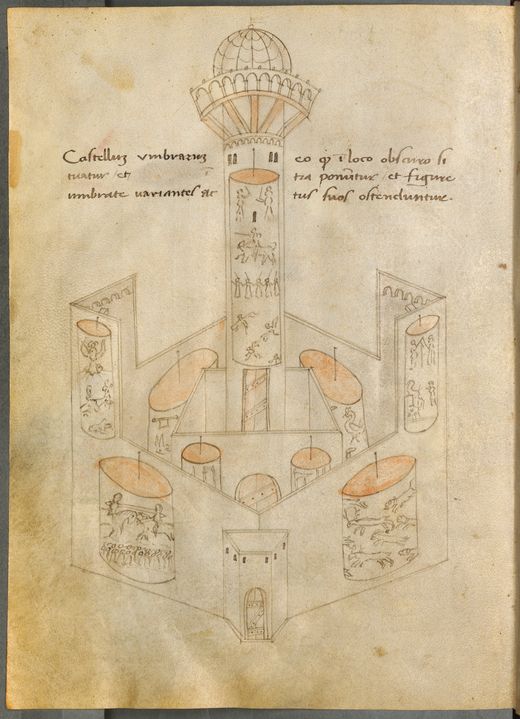
Parallel Italian memory-architecture tradition. Independently of the Bavarian Hausbuch class, the Italian ars memorativa tradition at Padua (Pelacani Questiones perspectivae 1390 → Matteo da Verona De Arte Memorandi 1420 → Ludovico da Pirano Regulae memoriae artificialis 1422 → Fontana Secretum de thesauro c. 1430) produced working memory-loci architectures with structural cognates to Cgm 7958's positional system. Cacopardo's 2021 Warburg PhD (read into substrate 2026-05-21) documents this tradition at the level Hartlieb would have known it during his Padua doctorate (1439). The most visually explicit witness is Giovanni Fontana's Bellicorum instrumentorum liber (BSB Cod. icon. 242), composed c. 1420 and partner-text to the cipher Secretum.
Provenance and access
Holding institution, access terms, and pointers to the digital surrogate.
The codex is held at the Bayerische Staatsbibliothek, München, under the Cgm (Codices germanici monacenses) classification; the detailed pre-BSB ownership chain is not currently surfaced in this draft. A complete digital surrogate is publicly accessible through the BSB-MDZ digital library platform, with image use subject to BSB's published terms; for citation use the preferred citation form above.
Last updated 2026-05-23.