Attribution methodology, three-band convention
The register uses three attribution bands. Each is recorded honestly with its load-bearing witness type named; none is treated as final.
Colophon-attested. Hartlieb is named directly in a manuscript colophon, rubric, or scribal note in a witness contemporary with his working life. Example: Cgm 7958 fol. 9r ("meister hanns hartlieb doctor medic[us]").
Text-attributed paratext (posthumous copy). The attribution appears in a paratext of the surviving witness, but the witness itself is a copy made after Hartlieb's death (1468). The attribution is real but mediated by the copyist. Example: Nürnberg, GNM, Hs 2186 (1507–09) for the Buch Trotula.
Tradition-attributed. Attached to Hartlieb by manuscript tradition, library cataloguing, or secondary scholarship. May be strongly held but lacks the direct in-manuscript hand.
Works register
Twelve entries. Sorted by genre cluster, iatromathematics and divination, medicine and gynaecology, Latin literary translation.
Witness data drawn from the Handschriftencensus (Werk 2317), KdiH 70.2, and Hayer & Schnell 2010. Witnesses 4–9 have been checked against the substrate register but not all have been directly inspected against primary-source images; acquisition status is noted per entry.
| Title | Date | Genre | Attribution | Primary witness |
|---|---|---|---|---|
| Kräuterbuch | 1440s–1450s | Herbal / materia medica | Colophon-attested | Berlin, SBB, mgq 2021 (base text, Hayer & Schnell 2010) |
| Mondwahrsagebuch | 1455/56 | Iatromathematics / lunar prognostic | Tradition-attributed | Heidelberg, UB, Cpg 6 · Wolfenbüttel, HAB, Cod. 29.14 Aug. 4° · Wien, ÖNB, Cod. 3062. (Note: not carried by Cgm 7958 per direct image inspection; the Cgm 7958 lunar apparatus is the 28-mansiones-lunae component of the onomatomantic engine, not the Mondwahrsagebuch tract proper.) |
| Onomatomancia / Namenmantik | 1455/56 | Name-sum divination apparatus | Colophon-attested | München, BSB, Cgm 7958 (fol. 9 self-attestation; iatromathematical onomatomantic engine + 28-mansiones-lunae apparatus + world-alphabet inventory + computus/sanctorale colophon) |
| Buch aller verbotenen Kunst | c. 1456 | Treatise on prohibited arts | Colophon-attested | Heidelberg, UB, Cpg 478 |
| Chiromancy | 1440s–1450s | Palm-reading apparatus | Tradition-attributed | Several Bavarian witnesses |
| Buch Trotula | composed 1460s; surviving witnesses 1460s–1570 | Gynaecology (Trotula translation) | Text-attributed paratext (in posthumous copies) |
Primary in-life / near-life witness: München, BSB, Cgm 261 (2. Hälfte 15. Jh.; text-only, no illustrations; carries the German Hartlieb Trotula + Secreta mulierum; on disk and locally HTR'd against the JHLTD substrate). This is the only one of the surviving cluster that is dated within Hartlieb's life-window or shortly thereafter. Later text-attributed paratext witnesses (posthumous copies):
Both 16th-century witnesses attest the Hartlieb text-tradition but not the manuscript-authorship; the in-life witness is Cgm 261. 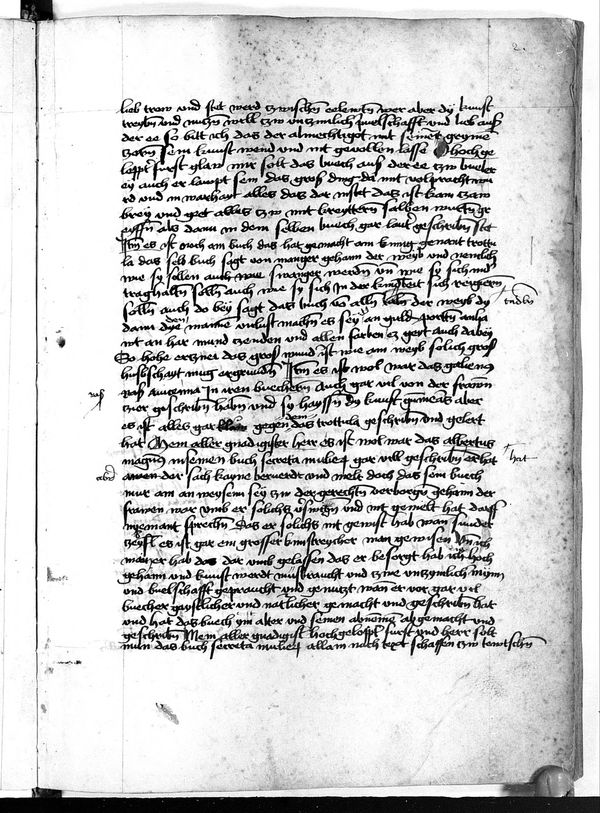

The two witnesses make the substrate finding visible: in-life Cgm 261 is a working text-only manuscript with no ceremonial paratext; posthumous Cpg 480 is the opposite, display calligraphy attribution paratext with the date inscribed in the same flourished hand, 102 years after Hartlieb's death. Both attest the Hartlieb text-tradition; only one carries an in-life manuscript-authorship anchor. |
| Secreta mulierum translation | 1460s | Gynaecology (pseudo-Albertus translation) | Colophon-attested | Bavarian witness cluster |
| Alexander romance | 1450s | Literary translation | Colophon-attested | Wittelsbach commission, multiple witnesses |
| Historia de Preliis (German) | 1450s | Literary translation (Alexander tradition) | Tradition-attributed | Witness cluster overlaps Alexander romance |
| Andreas Capellanus translation | 1450s–1460s | Literary / amatory treatise translation | Colophon-attested | Bavarian witness cluster |
| Buch von der Minne | 1450s–1460s | Literary / amatory treatise | Tradition-attributed | Linked to Capellanus translation tradition |
| Ovid translations | 1450s–1460s | Literary translation | Tradition-attributed | Bavarian witness cluster |
Last updated 2026-05-23.
Featured: Kräuterbuch witness table
The Kräuterbuch is the most heavily witnessed work in the corpus. The nine-witness table below records the principal manuscript witnesses, including direct folio observations on the Berlin base text (Hayer & Schnell 2010 critical edition) and on the Heidelberg and Nürnberg copies.
Witness sequence follows the Hayer & Schnell 2010 sigla where present. Folio-observation notes record sections directly inspected against digital surrogates or local image captures.
| Shelfmark | Repository | Date | Role | Observation |
|---|---|---|---|---|
mgq 2021 |
Berlin, SBB | um 1460 | Base text for Hayer & Schnell 2010 critical edition. Full register including animal-substance chapters 1–11. Bavarian-Austrian dialect. | §1–§8 dissection against MS 408; direct folio observations against printed edition apparatus and local PDF. |
Cod. 79 Aug. 2° |
Wolfenbüttel, HAB | um 1450 | Earliest complete, openly digitized witness. 174 illustrations, fully illustrated. Role: earliest-complete-openly-digitized-Hartlieb-witness. | 6 priority images fetched from HAB digital library. Openly accessible (HAB CC BY-SA). |
Cpg 311 |
Heidelberg, UB | um 1455/60 | Megenberg-embedded witness. Hartlieb herbal interpolated into Megenberg Buch der Natur (fols. ~244–315 substrate / fol. 225+ modern foliation). 308 illustrations made at Hagenau workshop. Rhinefranconian dialect. Lacks animal-substance chapters 1–11. |
Direct folio observations on digital surrogate (PDF on disk). Three-part template Identification → Virtues → Preparation confirmed at fols. 225–227.

|
Cod. 2826 |
Wien, ÖNB | 1450–1470 | Version W; alternative version for editorial recension testing. Hayer & Schnell apparatus. | Not directly inspected. Catalog record present. |
Hs. 18792 |
Nürnberg, GNM | 15th c. | Bound with an Iatromathematisches Hausbuch and a Theriak-Pesttraktat, a witness that bridges the Kräuterbuch tradition to the broader Beinecke MS 408-class apparatus neighborhood. | Not directly inspected. Catalog record present; full acquisition pending. |
Ms. 4 |
Linz, OÖ Landes-Kultur | ca. 1435–1450 | Earliest fragment by Werneck 1958 dating. Closest to autograph in the corpus. Innviertel provenance. | Not directly inspected. Acquisition pending institutional access. |
Ms. 46 |
Schloss Anholt (Salm-Salm) | um 1470 | Late-tradition witness, facsimile-only access. Hayer & Schnell apparatus. | Not directly inspected. Not currently accessible. |
Cod. D 684 |
Michelstadt, Nicolaus-Matz-Bibl. | Mitte 15. Jh. | Text-only, unillustrated baseline witness. No illustration program. Useful for separating text tradition from image tradition. | Not directly inspected. Not currently accessible. |
Nr. 2 |
Erbach, Gräfl. Erbachsches Gesamthausarchiv | Mitte 15. Jh. | Lost or untraced; recorded in Borchling and secondary literature. Hayer & Schnell apparatus notes. | Location uncertain; not currently accessible. |
Genre clusters
The twelve works divide into three working clusters. The clusters are descriptive, not exclusive, several works carry features across more than one.
The iatromathematics-and-divination cluster gathers the Mondwahrsagebuch, Onomatomancia / Namenmantik, Buch aller verbotenen Kunst, and Chiromancy, working apparatuses for prognostic and divinatory practice in a court medical context, with Cgm 7958 as the densest single witness for the Onomatomancia (the Mondwahrsagebuch tract proper is carried by Cpg 6, HAB Cod. 29.14 Aug. 4°, and Wien Cod. 3062 rather than by Cgm 7958). The medicine-and-gynaecology cluster gathers the Kräuterbuch, Buch Trotula, and the Secreta mulierum translation as the medical-practical core, with the Kräuterbuch carrying the most extensive witness tradition and the gynaecological works sitting at the centre of the Brewer 2021 competing-framework discussion. The Latin-literary-translation cluster gathers the Alexander romance, Historia de Preliis, the Andreas Capellanus translation, Buch von der Minne, and the Ovid translations, court-patronage literary work, with tradition attribution heavier in this cluster than in the medical and iatromathematical clusters.
Competing frameworks
The corpus has been read through different interpretive frames. This site tracks the principal competing framework explicitly rather than ignoring it.
Brewer 2021 advances a reading of the corpus that places the gynaecological content (Buch Trotula, Secreta mulierum translation) at the interpretive centre. The JHLTD program treats this as a properly scoped competing framework; the iatromathematical reading does not require the gynaecological reading to be false. Both can be retained on a witness-by-witness basis. This page records the framework without adopting it as the primary interpretive frame.